Mike Colias
AUTOMOTIVE NEWS
Published: November 4, 2014 10:32 am ET
Updated: November 4, 2014 10:41 am ET
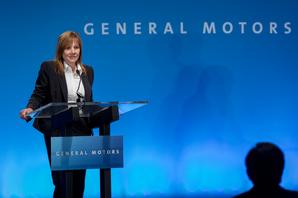
Image By: General Motors Co.
GM CEO Mary Barra at a recent conference.
DETROIT — Amid the recall maelstrom, General Motors Co. CEO Mary Barra has also made “building relationships” a key focus of her first nine months in the top job, from dealers to politicians to the media.
But repairing frayed ties with suppliers — a longstanding GM problem — might top the list. Barra told Automotive News last week that Detroit-based GM is “changing the way we do contracts” with suppliers, aiming to make it easier to do business with GM while also leveraging the company’s global scale.Automotive News is a sister publication ofPlastics News.
Increasingly, GM is awarding work for multiple generations of a vehicle program. It’s consolidating its supply base by awarding more global contracts, rather than divvying up work market by market. The combination of bigger upfront volumes and longer durations gives GM more scale and provides suppliers better visibility to plan their production capacity, she said.
“That allows them to deploy capital differently, to decide where they’re going to locate, potentially,” Barra said. “It changes the whole relationship, vs. ‘I’m buying 100,000 of these right now, give me your best price on that.’”
The tack reflects GM’s need for deeper ties with its suppliers to access innovation. GM executives have admitted that their historically contentious relationship with suppliers has put the company at a disadvantage as it competes with other automakers for technical know-how in powertrain, autonomous driving, infotainment and other key areas.
The current shift is an acceleration of a strategy put in place about three years ago under then-purchasing chief Bob Socia and continued by Grace Lieblein, who has been in the job since early 2013. Lately, supplier relations has been a pet issue of Lieblein’s boss: global product chief Mark Reuss, who oversees GM’s vast purchasing division.
Despite recent headway, Reuss says a lot of suppliers “really don’t believe in General Motors.
“They don’t believe in the volumes we ask them to tool for. They don’t believe in our portfolio, because things come in and out of the plan too regularly,” Reuss said in an interview last week. “Ultimately, they don’t believe we absolutely value their contribution from an efficiency or technology standpoint.”
Reuss says that uncertainty and mistrust don’t “give us the business relationship we need” to get the best innovation the supply base has to offer.
He says GM is trying to fix the problem in big ways — such as longer contracts — and small, such as more face time with supplier executives and emphasizing the “relationships matter” message to GM’s rank-and-file purchasing managers.
Barra hopes that GM’s recent playbook of bringing larger suppliers into the vehicle-development process earlier and giving them more long-term certainty will begin to erase the skepticism. Already, it has given a few suppliers enough peace of mind to build facilities near GM assembly plants in Spring Hill, Tenn.; Kansas City, Kan.; and Arlington, Texas.
“If I know in my plan that I’m going to build 800,000 [vehicles], why wouldn’t I structure the deal for 800,000 of them and allow the supplier to capitalize at the final level?” she said.
Dan Sharkey, a Detroit-area attorney who works with auto suppliers, said it’s rare for any automaker to award contracts for multiple generations of programs. He said it’s “a huge advantage that provides a lot more security and visibility.
“You can project your cash flows better; you can borrow off that future business; it gives you confidence to build a new facility or a new line,” Sharkey said.
But he also warned that GM and most other automakers typically allow themselves a contractual out if suppliers don’t agree to future price reductions.
|